
Mostrando entradas con la etiqueta BMM. Mostrar todas las entradas
Mostrando entradas con la etiqueta BMM. Mostrar todas las entradas
martes, 13 de enero de 2015

miércoles, 7 de enero de 2015
domingo, 23 de noviembre de 2014
domingo, 16 de noviembre de 2014
lunes, 3 de noviembre de 2014
¿Qué es un Mapa Estratégico y para qué sirve?
http://www.blogtrw.com/2011/12/que-es-un-mapa-estrategico-y-para-que-sirve/
Qué es y cómo se hace un Plan Estratégico
http://www.blogtrw.com/2011/12/que-es-y-como-se-hace-un-plan-estrategico/
http://es.m.wikipedia.org/wiki/Mapa_estrat%C3%A9gico
Mapas estratégicos. BSC, modelos de aplicación
lunes, 1 de septiembre de 2014
miércoles, 28 de mayo de 2014
miércoles, 21 de mayo de 2014
Positioning Enterprise Canvas in enterprise-architecture work
http://weblog.tetradian.com/2013/10/15/positioning-ecanvas-in-ea-work/
http://weblog.tomgraves.org/2011/07/26/from-biz-model-to-ea/
http://weblog.tetradian.com/2011/07/26/bmcanvas-to-archimate-short/
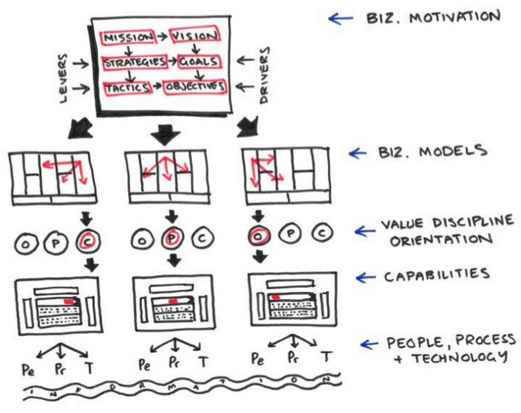
- Biz. Motivation: use Nick Malik‘s Enterprise Business Motivation Model (EBMM)
- Biz. Models: use Alex Osterwalder’s Business Model Canvas (BMC)
- Value Discipline Orientation: use the three orientations (‘Operational-excellence’, ‘Product-leadership’ and ‘Customer-intimacy’) to select an emphasis and orientation in a respective service to be modelled in Enterprise Canvas – typically:
- ‘Operational-excellence’: emphasis on combination of supplier-facing (left-side) and self (centre) in Enterprise Canvas
- ‘Product-leadership’: emphasis on self (centre) in Enterprise Canvas
- ‘Customer-intimacy’: emphasis on customer-facing (‘right-side) in Enterprise Canvas
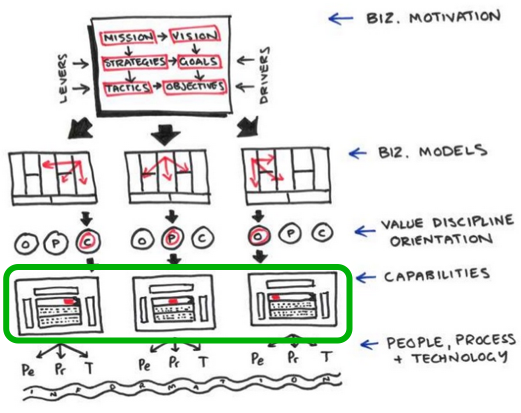
- Capabilities: model as services in Enterprise Canvas, perhaps using a translation via Archimate, such as described in the post ‘From business-model to enterprise-architecture‘, or more briefly in the post ‘Business Model Canvas to Archimate (the short version)‘
- People, Process + Technology: translate downward from Enterprise Canvas into UML,BPMN or other notations, as required
jueves, 15 de mayo de 2014
jueves, 17 de abril de 2014
BMM Description
http://fredacummins.blogspot.com.es/2013/06/strategic-planning-with-vdml.html
Overview of BMMThe diagram, below, is an abstraction of the Business Motivation Model (BMM) taken from the OMG specification. I will briefly discuss the Means and Ends that represent a strategic plan. Influencers and Assessment are elements of the strategic planning process that provide input for development and refinement of the plan, but they are not, per se, elements of a strategic plan.
End
The End contains elements that define the desired future characteristics of the enterprise including the Vision and Desired Result.Means
The Means contains elements that describe how the future state of the enterprise will be achieved including Course of Action and Directives.Vision
A strategic plan, at the most abstract level, is expressed as a Vision of what the enterprise wants to be and how it wants to be perceived. This is complementary to the Mission.Mission
The Mission expresses why the enterprise exists--what it wants to accomplish. Successful pursuit of the Mission should support realization of the Vision.
Desired result
The desired result consists of Goals and Objectives.
Goal
A goal is a long-term, qualitative result that the enterprise may already be pursuing or that may be advanced as a result of a business challenge or opportunity. It defines a purpose for the strategy.Objective
Objectives are specific, measurable results to be achieved by a strategy and support enterprise goals. While there may be many measures of performance, objectives focus on selected, key measurements that reflect progress toward the strategy and goals from a management and investor perspective.Course of Action
A course of action is the approach to implementation of the Mission in pursuit of the Goals and Objectives. It consists of Strategy and Tactics.Strategy
A strategy defines how the mission will be pursued and objectives will be achieved. In conventional strategic planning, it is an abstract description of how the enterprise will operate in the future. Typically, there will be multiple aspects to a strategy, potentially representing the integration of different ideas.Tactic
Tactics are incremental changes to the state of the enterprise that lead to the desired future state required by the Strategy. The distinction between strategy and tactics is somewhat subjective. Tactics will focus on resolving particular problems and steps toward implementing related changes.Directives
Directives are the business policies and business rules that are to be incorporated in the future state of the enterprise.Business policies
Policies are statements of business operating requirements.Business rules
Business rules define operating criteria or constraints in specific circumstances. Business rules implement business policies.lunes, 7 de abril de 2014
domingo, 6 de abril de 2014
BA and Canvas
http://enterprisearchitects.com/webinar-feb-2014/
Webinar: Using Business Architecture to Enable Customer Experience and Value Strategies
http://weblog.tetradian.com/2013/10/15/positioning-ecanvas-in-ea-work/
sábado, 29 de marzo de 2014
miércoles, 12 de marzo de 2014
martes, 11 de marzo de 2014
Capabilities Links
Capability
Value Stream
http://www.cutter.com/content-and-analysis/resource-centers/enterprise-architecture/sample-our-research/ear1102.html
http://www.bainstitute.org/resources/articles/capabilities-value-streams-business-architectures-essential-alliance
http://www.businessarchitectureguild.org/Resources/Documents/Business%20Architecture%20is%20THE%20REAL%20Tie%20that%20Binds.pdf
http://www.linkedin.com/groups/Capability-mapping-4379346.S.5840228104378802176?trk=groups_most_recent-0-b-ttl&goback=%2Egmr_4379346
domingo, 9 de marzo de 2014
Suscribirse a:
Entradas (Atom)