https://www.linkedin.com/pulse/architecture-roles-matthew-kern-msea-cea-pmp-itil-cissp-issap
http://www.enaxisconsulting.com/p-it-strategy-governance
Is your strategy on solid ground?
Our approach draws from our experience in working with Energy clients, knowledge of technology trends, and understanding of organizational structures and talent management in IT, as well as a methodology that is based on equal parts external and internal drivers. Our deep technology credentials gives us distinctive insight across all levels in establishing a successful IT Strategy.
IT Strategy
We work at multiple levels based on our clients’ needs to define the enterprise IT Strategy or for a specific function or area. Our consultants bring an experience based understanding of the Energy business (upstream, midstream, downstream and utilities), technology trends, and business needs to help develop an IT strategy that will support and enable the broader business goals. We work with clients to define application strategies, ERP strategies, Infrastructure strategies, collaboration strategies, outsourcing strategies and others. We also have industry-specific experience around IT strategies for Upstream Application Portfolio or Pipeline Connectivity strategies or IT Infrastructure to support Smart-Grids for utilities.
IT Governance
Successfully implementing an IT strategy requires an organization and governance model tailored to the specific organization and the defined IT strategy. We help support IT strategy execution by designing the right organizational structure, governance model, decision-making processes and KPIs. We perform client workshops and team-building exercises to implement the right structures to achieve a successful strategy.


http://stevegeorghakis.blogspot.com.es/p/business-driven-it-strategy.html
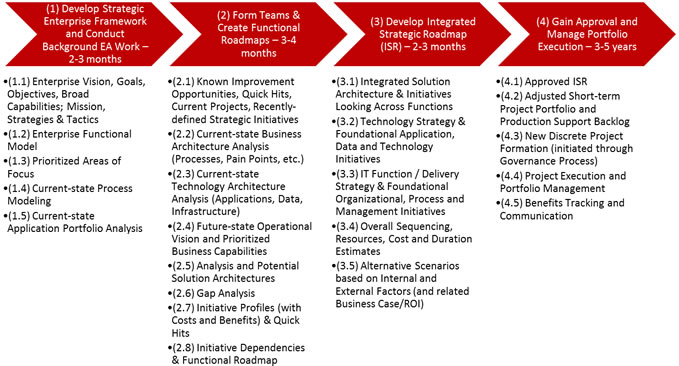
Overview
Companies with well-conceived business and IT strategies and plans (BDITS) operate more effectively than those without. It is necessary for these strategies and plans to span a 3-5 year horizon in most cases due to the magnitude of work required to fully implement necessary solutions. The benefits of creating and sustaining a well defined BDITS include:
(1) Develop Strategic Enterprise Framework and Conduct Background EA Work
This set of activities involves defining the strategic aspects of the future-state that the company intends to put in place, and performing the background work on the current-state business operation to prepare for the next stage of work. Effective current-state work products will help to focus subsequent BDITS activities and reduce the time and cost of external consulting assistance to help analyze and document the current-state.
(2) Form Teams and Create Functional Roadmaps
This set of activities involves applying the strategic inputs defined in Phase 1 – above, and applying them broadly to the enterprise across functions AND in an in-depth manner in priority functional areas of focus. For all functional areas, high-level pain points and improvement opportunities are gathered from existing data and information (e.g. desired projects, open IT enhancement requests, recently conducted analyses, etc.) and several work sessions are conducted with business and IT leaders in these areas. For priority areas of focus, more detailed work is performed involving an extensive analysis of the current-state business and technology operation, definition of functional business objectives, creation of a vision of how the company wants to operate in this functional area in the future (using strategic inputs defined in Phase 1), definition of detailed business capabilities which must be put in place to meet functional objectives, a gap analysis of where the company stands today versus the future desired vision, and a plan (which will address people, process and technology) for achieving the desired future vision over the next 3-5 years. Functional roadmaps defined in Phase 2 are a key input to the Integrated Strategic Roadmap (IRS) developed in Phase 3.
(3) Develop Integrated Strategic Roadmap
The integrated strategic roadmap is Phase 3 of the BDITS initiative and involves synthesizing the functional roadmaps created in Phase 2 and creating an overall solution architecture for implementing appropriate initiatives defined in the functional roadmaps. It is important to note that it is highly likely that not all of the initiatives defined by the functional teams during Phase 2 will “make the cut” in the Integrated Strategic Roadmap (for reasons which involve potential overlap and redundancies with initiatives created by other functional teams, overall capacity of the organization to implement solutions and other sequencing issues related to the nature of the underlying foundational technology which must be put in place to support all of the functions in aggregate).
(4) Gain Approval and Manage Portfolio Execution
This final major phase refers to the approval gained from the Board and Executive Committee to move forward with the implementation of initiatives defined in the BDITS, and then the subsequent adjustments to the existing portfolio and formation and launch of specific BDITS projects.
http://stevegeorghakis.blogspot.com.es/p/framework-for-strategy-governance.html
Many organizations struggle with the combination of strategic and tactical activities necessary to maximize the value of IT investments. There are literally dozens of activities that need to be executed in an integrated fashion in order to fully leverage the power of Information Technology to power the enterprise.
The following graphic describes four critical areas of focus, which have many points of integration with each other ... all tied together by effective IT governance (both strategic and tactical):
http://www.infotech.monash.edu.au/units/archive/2014/s1/fit3136.html
Week
Activities
Assessment
0
No formal assessment or activities are undertaken in week 0
1
Strategic contexts of organisations
Tutorials begin in Week 1
2
IT strategy and business strategy
3
IT strategy alignment
4
IT governance
5
IT governance (continued from Week 4)
6
IT processes
7
IT systems success and failure
Assignment 1 is Due
8
Funding IT function
9
IT outsourcing
10
Legal issues with IT
11
Legal issues with IT and Green IT
12
Unit review and exam discussion
Assignment 2 is Due
SWOT VAC
No formal assessment is undertaken in SWOT VAC
Examination period
LINK to Assessment Policy:http://policy.monash.edu.au/policy-bank/
academic/education/assessment/
assessment-in-coursework-policy.html
*Unit Schedule details will be maintained and communicated to you via your learning system.
http://www.pwc.com/ca/en/technology-consulting/technology-advisory/it-strategy-governance.jhtml
PricewaterhouseCoopers can help you develop a technology strategy aligned to your business objectives. Our team of seasoned advisors have helped clients in many industries using their experience in IT architecture, IT management, IT governance, compliance, risk, IT sourcing and service delivery.
If your business needs a strategy or governance structure to improve the effectiveness of your IT operations, our team can provide a tailor-made solution to get your IT function on track.
How PwC can help
Leveraging PricewaterhouseCoopers’ leading methodology and frameworks including our TRANSFORM™ IT framework, we help you develop:
Contact us to find out how we can help you with your IT strategy.


